GET 15% OFF ON YOUR FIRST ORDER WITH CODE "KF"
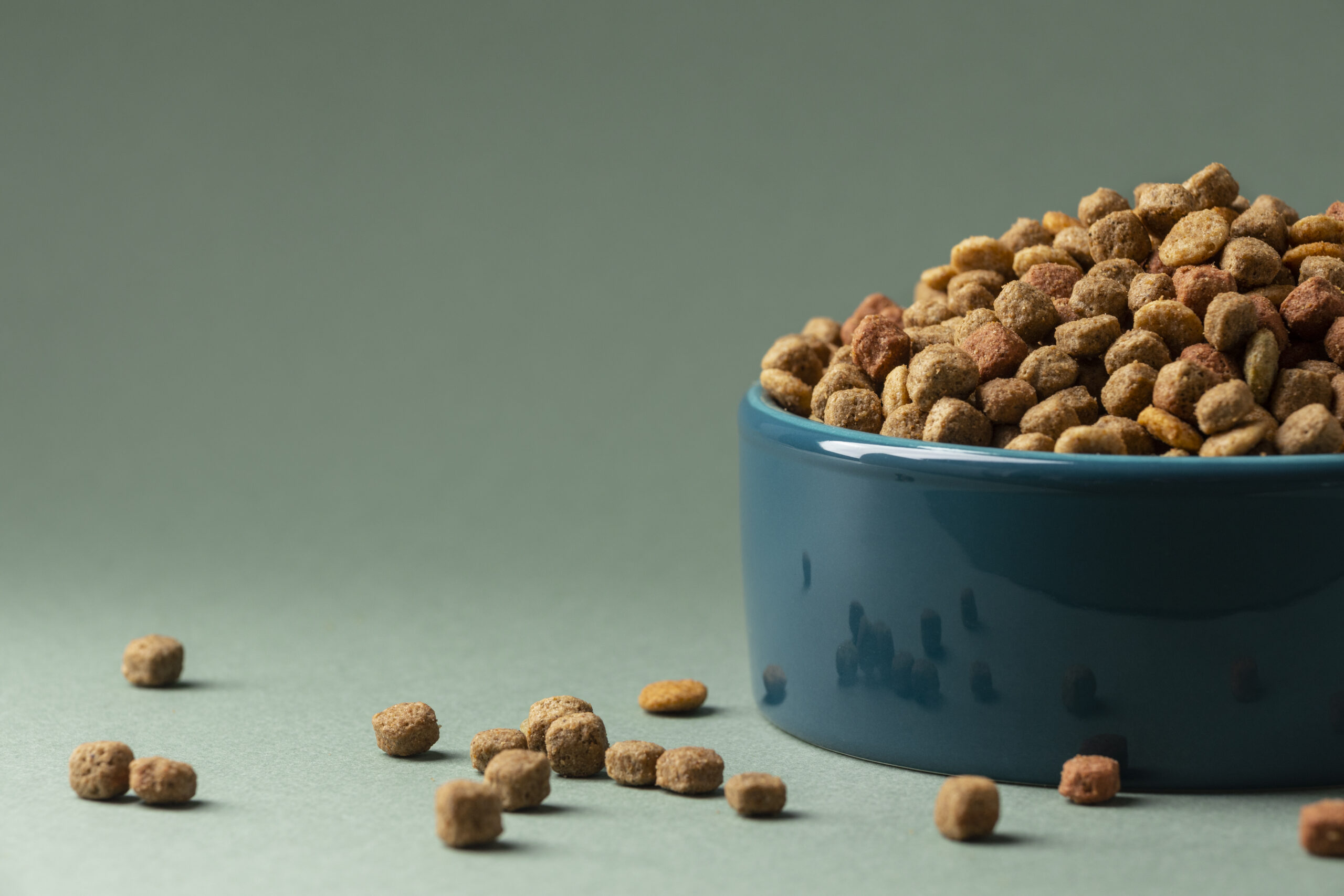
For years, kibble has been the most practical and popular way to feed our pets. It lasts for months, it’s easy to serve, and it’s everywhere. But behind that convenience are industrial processes, heavily processed ingredients, and an environmental cost worth considering when choosing your dog’s food.
How it’s made
Kibble is made through a process called extrusion, where grains, animal proteins, fats, and additives are mixed and then cooked under high temperature and pressure. This reduces moisture and prevents spoilage, allowing storage for 12 to 24 months without refrigeration.
Heat and pressure improve shelf stability, but they can also destroy part of the vitamin content and affect natural amino acids. That’s why many commercial brands add synthetic supplements to meet AAFCO nutritional levels.
Protein… but not necessarily fresh meat
Even though packaging often shows juicy pieces of meat, most kibble is made with rendered meals or byproducts like meat meal or poultry by-product meal. Rendering cooks and dehydrates animal tissues to turn them into protein powder. It’s an efficient way to preserve protein, but depending on raw materials and processing intensity, it can affect amino acid profiles and digestibility.
What heat takes away
High extrusion temperatures can degrade a large portion of natural vitamins and antioxidants — sometimes up to 70% depending on nutrient type and processing conditions. That’s why most manufacturers add synthetic vitamins and minerals after cooking. While this helps the product meet minimum levels, nutrients may not maintain the same bioavailability or stability during long storage.
Artificial additives
Over time, dry food can lose aroma and color. To keep it appealing for months, many manufacturers add antioxidants, palatants, and artificial colorants. Common ones include BHA, BHT, and ethoxyquin — synthetic compounds used to prevent fats from going rancid and to keep the product’s smell and appearance stable. Their goal is shelf life and stability — not nutritional value.
The environmental cost of kibble
Beyond nutritional complexity, kibble carries a significant environmental cost. Manufacturing requires large amounts of energy, water, and transportation — to process ingredients and maintain distribution. Extrusion and drying are among the most energy-intensive processes in food manufacturing, and multi-layer plastic packaging creates recycling challenges.
Convenient doesn’t always mean best
Kibble was created to be relatively safe, stable, and accessible — and it generally achieves that. But it’s also an industrial product that is resource-intensive, includes heavily processed ingredients, additives, and a meaningful environmental footprint.
That’s why, beyond marketing, the most important thing is to stay informed, read labels, and choose transparent brands that clearly explain ingredient sourcing and sustainability commitments.
And after all… it’s worth asking what would truly make your dog happiest.
Who would want to eat dehydrated, ultra-processed food with artificial additives every day for their entire life?
FDA, AAFCO, FEDIAF, PetfoodIndustry, PLOS One y Frontiers in Veterinary Science. Redacción original con base en literatura científica y fuentes públicas.”
Referencias:
– Tran et al., Journal of the Science of Food and Agriculture (Wiley, 2008): https://onlinelibrary.wiley.com/doi/10.1002/jsfa.3247
– PetfoodIndustry (2022): https://www.petfoodindustry.com/production/article/15467357/optimizing-extruded-pet-food-production- FDA – Ingredients & Additives for Animal Food: https://www.fda.gov/animal-veterinary/animal-food-feeds/ingredients-additives
– AAFCO – Ingredient Standards: https://www.aafco.org/consumers/understanding-pet-food/ingredient-standards/
– PetfoodIndustry (2023) – Rendered Ingredients Support $51.7B Pet Food Industry: https://www.petfoodindustry.com/nutrition/pet-food-ingredients/news/15742362/report-rendered-ingredients-support-517b-pet-food-industry
– Pet Food Institute (2020) – Pet Food Production Report: https://www.petfoodinstitute.org/wp-content/uploads/20200310-Pet-Food-Report-FINAL.pdf, https://onlinelibrary.wiley.com/doi/10.1002/jsfa.3247
– Frontiers in Veterinary Science (2024): https://www.frontiersin.org/articles/10.3389/fvets.2024.1410077/full
– Rokey et al., PetfoodIndustry (2022): https://www.petfoodindustry.com/production/article/15467357/optimizing-extruded-pet-food-production
– FDA – Antioxidants in Pet Food: https://www.fda.gov/animal-veterinary/animal-health-literacy/antioxidants-pet-food
– EFSA (2020) – Evaluation of BHA and BHT: https://www.efsa.europa.eu/en/efsajournal/pub/6110
– Okin, G. S. (2017), Environmental impacts of food consumption by dogs and cats, PLOS One: https://journals.plos.org/plosone/article?id=10.1371/journal.pone.0181301
– FEDIAF (2023), Environmental Footprint Report: https://fediaf.org/images/FEDIAF_Environmental_Footprint_2023.pdf
– PetfoodIndustry (2023) – Energy Efficiency in Extrusion: https://www.petfoodindustry.com/production/article/15467368/energy-efficiency-and-sustainability-in-pet-food-extrusion
– AAFCO (2024): https://www.aafco.org/resources/
– Frontiers in Animal Science (2025): https://www.frontiersin.org/journals/animal-science/articles/10.3389/fanim.2025.1506003/full